A Lebanese Technology Transfer
Notes on a blowup

Postface to Abi-Rached and El-Richani’s Lebanon: Anatomy of a Collapse
I would like to repeat an aphorism that Lebanon has twice the qualities found in the Mediterranean world, but twice the flaws. This can generalize beyond the Mediterranean: Lebanon can be a place to study both societal functioning and its maladies.
For the Lebanese crisis under discussion in this volume appears to be a rare confluence of three ailments hitting a country as if by some conspiracy of providence. And by some divine coincidence, the solution is also found in Lebanese (more generally North Levantine) history.
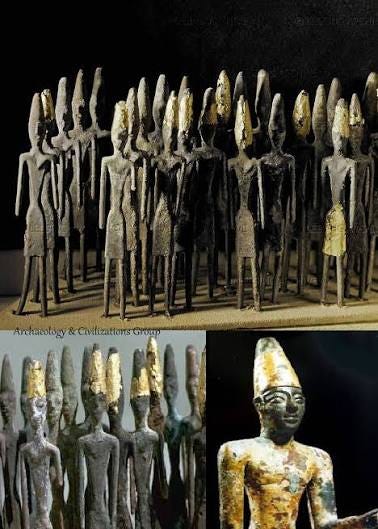
This author, who grew up in Lebanon (and never really left it socially and intellectually), happens to specialize (in both academic research and business activities) in these exact three major ailments –though applied to Western societies and financial markets. By a curious technology transfer, yours truly generalized from Lebanon and applied overseas.
Primo, there is what one can call the carry trade (or the active concealment of risk under the rug); secondo, there is the risk transfer between agents (skin in the game); and, tertio, there is the fragilization of an economy by stifling the market signals and dampening its natural intellectual and business fertility. And what is the remedy? The building of a system along the lines found in Lebanese history, something called antifragility.
The “carry trade” is as follows. Start producing steady returns while hiding some tail risk in the corners. People will invest. Keep going. Then they will invest more. At some point, some will give you all their savings. Then the greediest (and risk-blind) will blow up and nobody will hear of them. Owing to the survivorship bias, their losses will be both absent from the collective consciousness and, worse, from much of the salient record. Losers don’t write books (if they did nobody would publish them) and, as every financial statistician would confirm, dead entities are not listed in phone books, dead stocks are not easily found on Bloomberg lists, and the wisdom and the experience of bankrupt people isn’t found on the shelves of your local bookstore.
There are accounting and psychological explanations for the appeal of the carry trade as well as an inordinate amount of hidden moral hazard.
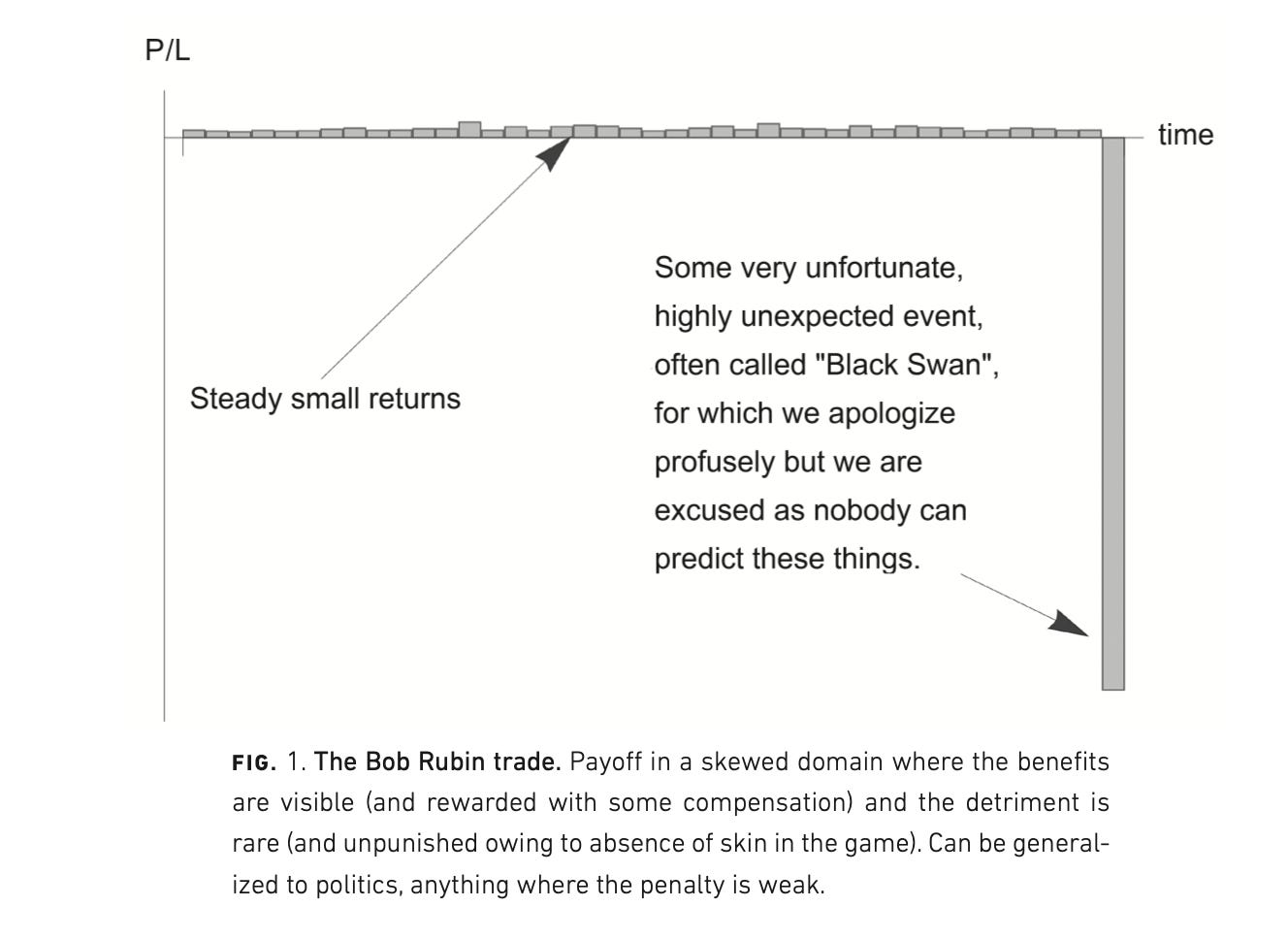
First, let us start with the way investors and depositors like to fool themselves with hidden risks that blow up on the occasion. Kahneman and Tversky showed empirically (see this author’s many interpretations1) that the value function (the equivalent to the conventional utilility in their framework) is concave in the gain domain and convex in the loss domain. This means that, hedonically, making small gains repeatedly and losing the bulk (and more) suddenly brings more psychological satisfaction than the reverse, that is, losing (or underperforming) continuously and gaining abruptly. This invites the selling of tail events for pennies.
Second, the moral hazard, the “crooks of randomness” effect, or the Robert Rubin Trade, covered in Skin in the Game. Robert Rubin, when he was the vice-chairperson of Citi, made close to a hundred million dollars in bonuses over a decade for a trading strategy that sells the tails and hence benefits from absence of volatility. When Citi lost everything and more from such fragile betting on the tails, all he had to do was invoke an unexpected event nobody foresaw, a “Black Swan after a (very) stubborn Lebanese author-trader”. And he kept his 100 million dollars and his Fifth Avenue apartment while the taxpayer had to directly and indirectly bail out Citi.
Recall that U.S. money center banks (including the very same Citi) lost every penny they ever made in their history on a single event, in the summer of 1982, from emerging market loans that defaulted collectively, something that convincingly shows that the Robert Rubin Trade is going to be repeated at some point in the future. Furthermore, the entire analytical apparatus of the financial economics establishment, based on the Gaussian distribution, deemed these strategies “safe”. A couple of “Nobel” laureates in economics (that is the Medal in honor of Alfred Nobel) were fooled by it as they blew up and lost their own fortunes, particularly in 1998 with the bankruptcy of Long-Term Capital Management. Likewise another “Nobel”, Joseph Stiglitz, deemed the tail risks of FNMA (which ended up with a blowup of 600 billion) as non-existent. For the economics establishment, the tails were deemed expensive, hence irrational to not sell –a belief that mysteriously lingered without any empirical backing.
Now something similar happened in Lebanon, couleur locale. Depositors were making steady income from the carry trade and fooled by it –it is remarkable how fooled investors like to theorize to justify their strategy (Nobel or no Nobel). The central bank delivered to them the ideal Ponzi: it created fake local U.S. dollars that yielded more than the real U.S. dollar, and that at a time when U.S. rates went to literally zero (as a consequence of the generalized bailout of the system after the blow-up of the Robert Rubin Trade). The differential was, in their eyes, compelling. This attracted every carry hog in Lebanon and even among Lebanese expatriates.
The problem with the carry trade is that it came with the necessary artificial stabilization of the Lebanese Lira, in order to give the impression of a “dollarization” of the local economy. Yet nothing fragilizes more than artificial stability. People liquidated their businesses, workshops, and legit activities just to invest in a supposedly “risk-free” deposit yielding 7%. Many people retired prematurely. The Central Bank ended up sucking away all funds from the economy for that stabilization business.
This was particularly painful to this author. For my personal strategy is as follows. Find anything that produces steady returns, take the other side, and wait for the blowup. Then wait again for new suckers to enter the market –often the same suckers return for more; engaging in a certain class of trades is imprinted in some people’s genetic makup2. I gave a talk sponsored by the Lebanese Central Bank at AUB in 1998 called “unsafe at any speed” (a Ralph Nader title), causing me to receive all manner of insults for the following twenty years from people who subsequently had to come ask me for a personal loan.
Now let’s look at the positive. I will leave it to a commentary by one of the great living historians:
In the revision of the seminal 1177: The Year Civilization Collapsed, Eric Cline discussed this author’s Antifragile. He wrote about the Canaanites:
“(…) They may actually have been among the most resilient of the peoples whom we are examining” (...) for they not only apparently carried on from the initial Canaanite city-states but even flourished in the vacuum created by the Collapse.
Thus, we may well suggest that the Canaanite survivors in these cities, now identified by specific city (e.g., Sidon) or simply rechristened as generic “Phoenicians” by the Greeks as early as the time of the Homeric epics, were more than simply resilient in the face of the Collapse.
They might be better referred to as “anti-fragile” to borrow a term from Nassim Nicholas Taleb. “anti-fragile” can be used to describe a situation in which an entity exhibits more than just resiliency or robustness, and actually “thrives under the right amount of stress” — taking advantage of the situation not only to survive but to flourish. Taleb describes it specifically as “things that gain from disorder”. In the case of the Phoenicians, they seem to have actively taken advantage of the chaos and, most important, of the destruction of Ugarit in northern Syria, to take over the maritime trade routes to the west, across the Aegean to Greece and thence further to Italy, Sicily, and Sardinia.
So for those worried about the inevitable recurrence of the Bronze Age Collapse –the collapse of the large powerful states trapped by their overdependent structures –my answer is that there is a great chance that history will be kind, for a second time, to that hard-to-tame Canaanite strip.
NOTES: A more technical note on the Ponzi scheme. First it is characterized by crescendo borrowing, with debt servicing increasing in a multiplicative way. Second, governments issuing debt in their own currency (unlike Riad) are relatively shielded as they can transfer the effect to that sneaky think we call inflation thanks to the beastly printing press. Third, note that nobody in known history has been able to survive a Ponzi, meaning that it is always a matter of time and that trade is the kind of thing for suckers. Actually the unavoidability of the collapse can be easily shown mathematically. A banker engaging in a Ponzi is necessarily –as I insisted with the case of the public vilain Antoun Sehnaoui –totally incompetent.
1 See Taleb, N. N. (2004). Bleed or blowup? Why do we prefer asymmetric payoffs?. The Journal of Behavioral Finance, 5(1), 2-7, and Taleb, N. N., and G. Martin. “How to Avoid Another Crisis.” SIAS Review of International Affairs (2012).
2 See Malcom Gladwell, 2002, “Bleed or Blowup, How Nassim Taleb turned the inevitability of disaster into an investment strategy.” The New Yorker.